
Introducing MultichainZ DAO Governance
A Decentralized Framework for Protocol Development

As the decentralized finance (DeFi) space grows, effective governance becomes essential for protocols like MultichainZ, which aim to maintain transparency, security, and community-driven evolution. MultichainZ presents a governance model built on a decentralized autonomous organization (DAO) framework. This governance system enables a seamless and secure mechanism for users to propose, vote, and implement changes within the protocol, ensuring alignment between various stakeholders and long-term growth. Here's an in-depth look at how governance works within the MultichainZ ecosystem.
The Three Governance Layers in MultichainZ
The MultichainZ DAO Governance Protocol is built on three main layers that ensure comprehensive protocol management:
1. Governance Core Layer: This layer handles all key aspects of governance, including proposal creation, voting, and execution of approved proposals.
2. Security Layer: This layer focuses on protecting the protocol and its users. The MTZTimelock Upgradeable Contract introduces a mandatory waiting period between proposal approval and execution, allowing the community to react if necessary.
3. Governance Token Layer (ChainZ Token): ChainZ tokens enable holders to participate in protocol governance. This layer uses ERC20Votes, which incorporates historical balance tracking, enabling accurate calculation of voting power.

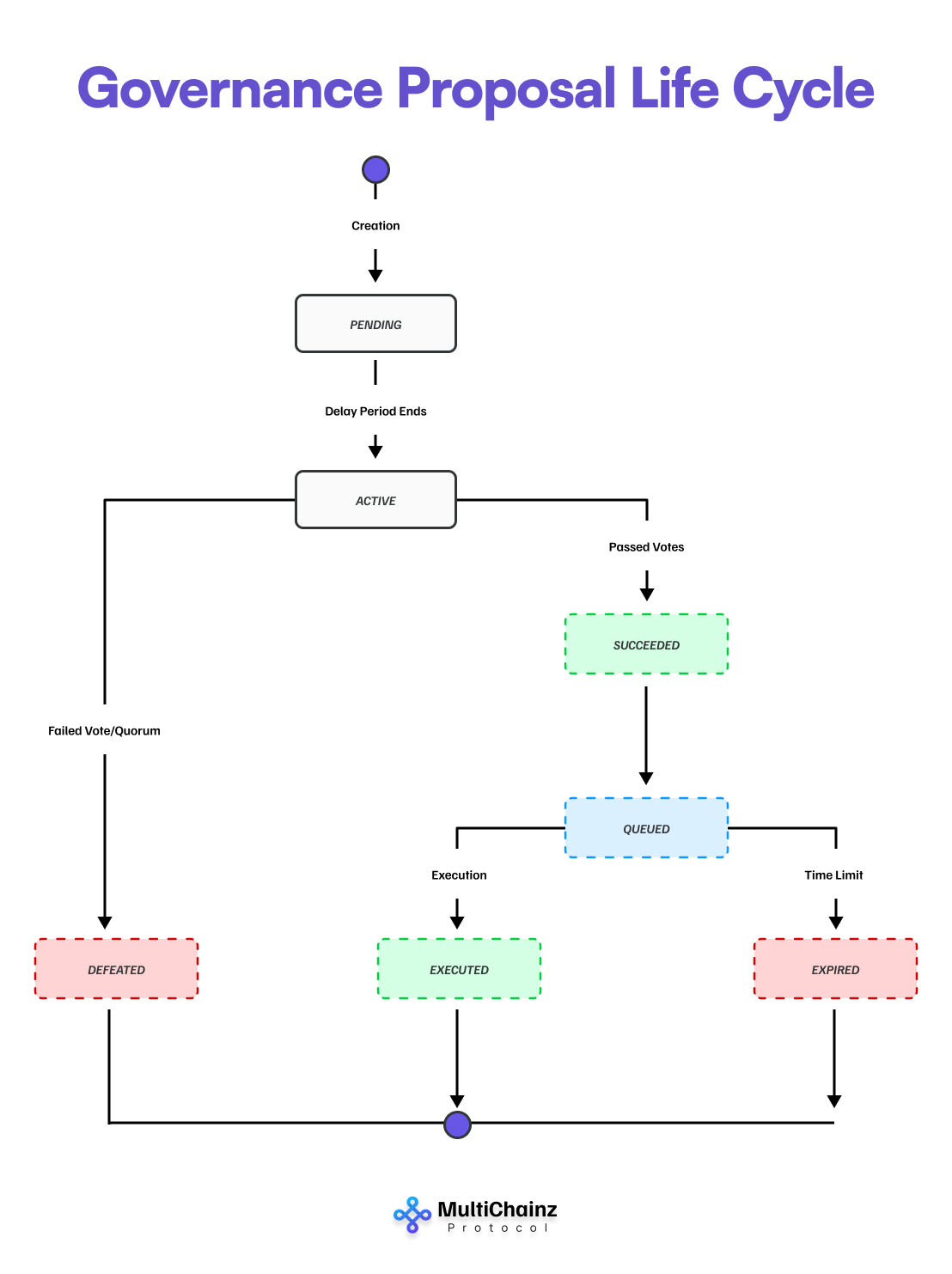
The proposal lifecycle in MultichainZ follows a structured state machine process that consists of several distinct stages:
1. Pending (Initial State)
- When a proposal is created, it enters the "Pending" state. During this phase, a delay period (configurable by governance) prevents immediate voting, allowing the community to review the proposal thoroughly.
2. Active (Voting Phase)
- Once the delay period ends, the proposal becomes "Active," and ChainZ token holders can cast their votes, choosing “For,” “Against,” or “Abstain.” Each vote is weighted based on the holder’s token balance, as captured in a snapshot at the proposal's initiation. Voting options include direct voting, voting with a reason, gasless voting by signature, or delegated voting.
3. Succeeded or Defeated (Vote Evaluation)
- After the voting period ends, the proposal is evaluated. It "succeeds" if it reaches quorum (the minimum participation threshold) and has more "For" votes than "Against." Otherwise, the proposal is “Defeated” and doesn’t proceed further.
4. Queued (Post-Success Security)
- Successful proposals enter a timelock queue, which implements a waiting period before execution. This security measure protects against potential malicious activity, giving the community time to cancel proposals if necessary.
5. Executed or Expired (Final State)
- After the timelock period, authorized executors carry out the proposal’s actions. If the proposal is not executed within a set timeframe, it expires. This final stage enforces that all actions within the proposal succeed or revert entirely if an error occurs.
Diagram Flow
Security Mechanisms in MultichainZ Governance
The Security Layer is a key component of MultichainZ’s governance system, enforcing strict access control and proposal review processes to protect the protocol. The MTZTimelockUpgradeable Contract serves as the backbone of this layer, mandating a minimum delay period before execution and preventing unauthorized proposals.
Additionally, the governance model uses RBAC, assigning each role distinct permissions to enhance security:
- PROPOSER_ROLE: Authorized to create new proposals.
- EXECUTOR_ROLE: Permitted to execute proposals after the waiting period.
- CANCELLER_ROLE: Authorized to cancel proposals during the pending state.
- GUARDIAN_ROLE: Holds emergency override powers to ensure platform integrity.

ChainZ Token (CHAINZ): Governance Token and Voting Power
The ChainZ token, based on ERC20Votes, serves as the governance token within MultichainZ. Its sophisticated voting capabilities include snapshot-based balance tracking to prevent voting manipulation, making each vote fair and tamper-proof.
Key Features of ChainZ Token Governance:
1. Voting Power Tracking: Snapshots capture token balances at the start of each proposal, ensuring that voting power is stable and free from last-minute token transfers or flash loan exploits.
2. Delegation System: ChainZ token holders can delegate voting power to other community members, allowing both direct and proxy voting participation.
3. Token Utility: ChainZ tokens are required for proposal creation, serve as proof of stake in the ecosystem, and provide voting weight in governance decisions.

Participating in MultichainZ Governance
1. Access the "Governance" Section** within the MultichainZ app.
2. Review Proposals carefully and join discussions on the governance forum.
3. Cast Your Vote by selecting a vote option and confirming your choice.
4. Change Your Vote if needed, by following the same steps. Your previous vote will be overridden.
Note: Your token balance should remain the same or higher throughout the voting period to maintain vote validity.
The Dynamic Voting Threshold: A Balanced Approach to Governance
The MultichainZ protocol uses a dynamic threshold system that adjusts based on vote activity. If there is substantial opposition to a proposal, the threshold is raised, requiring more supportive votes for the proposal to pass. This feature ensures that major protocol changes are made with a strong consensus.
Conclusion
The MultichainZ governance framework integrates advanced security, flexibility, and community involvement, creating a transparent and autonomous decision-making process. By holding ChainZ tokens, users play a direct role in shaping the future of MultichainZ. Whether you’re proposing an improvement or casting a vote, your participation helps drive innovation within the MultichainZ ecosystem.
For a more technical deep dive into the governance mechanisms, please visit our Developer Docs.
Good Project